
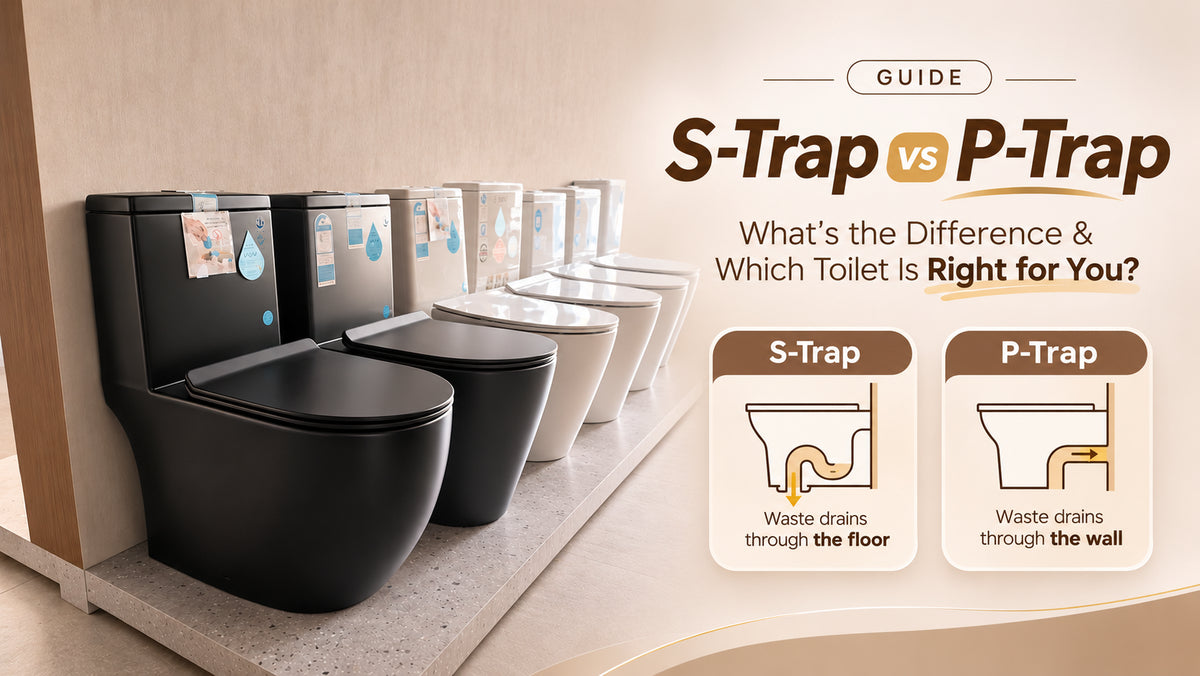
Replacing a toilet bowl in a Singapore HDB flat, BTO or condominium? Before choosing a design, check how the toilet connects to the existing waste outlet. The difference between an S-trap (floor outlet) and a P-trap (horizontal outlet) affects which toilet models and connectors may be suitable.
What you need to know: An S-trap toilet generally discharges down into a floor outlet, while a P-trap toilet has a rear horizontal outlet, commonly connected towards a wall. However, some P-trap designs may connect to a floor outlet using an appropriate rigid bend connector when the product specification and site conditions allow it. Always confirm the actual outlet position before ordering.
 Illustrative only. Internal water-seal and trapway designs vary by manufacturer and toilet model.
S-Trap vs P-Trap toilets: the main differences
| Feature | S-Trap toilet | P-Trap toilet |
|---|---|---|
| Typical outlet direction | Downwards through the floor | Horizontally from the rear of the pan |
| Key site measurement | Finished wall to the centre of the floor outlet (rough-in / setout) | Finished floor to the centre of the wall outlet, plus connection clearance |
| Common installation consideration | Matching the floor outlet position to the specified rough-in or approved connector | Matching wall outlet position, or checking whether the pan supports a compliant rigid bend to a floor connection |
| Can the model fit every home? | No — rough-in and dimensions vary | No — outlet height, space and connector geometry vary |
This table is a buying guide, not a substitute for the manufacturer's installation drawing or an assessment by a PUB Licensed Plumber.
What is an S-Trap toilet bowl?
An S-trap toilet is designed to direct wastewater downwards into a floor waste outlet. It is frequently encountered when replacing conventional floor-mounted toilet bowls in Singapore homes. The critical specification is the rough-in distance: the horizontal distance from the finished wall behind the bowl to the centre of the floor outlet.
Toilet models available in Singapore may specify setouts such as approximately 150 mm or 250 mm, among other dimensions. Those figures are examples, not universal HDB or condominium standards. A bathroom that has been retiled or renovated may have different effective clearances.
What is a P-Trap toilet bowl?
A P-trap toilet pan has a horizontal outlet at the rear. It is commonly used where the sanitary connection runs towards a wall. For a wall outlet, the height of the waste pipe centre above the finished floor is especially important.
Important: A horizontal-outlet pan is not always limited to direct wall connections. Certain toilet models can be connected to a suitable floor outlet with an approved rigid bend connector. The choice depends on the manufacturer's drawing, the connector geometry, the existing waste outlet and the plumber's assessment. Do not assume that any P-trap model can be adapted to any S-trap position.
How to measure your toilet outlet in Singapore
1. Check whether the waste outlet enters the floor or wall
Look at the current arrangement and, if available, the previous toilet's installation drawing. If the pipe is concealed by a back-to-wall pan or boxing, do not guess based on the visible shape alone. Ask your contractor or plumber to verify the connection.

2. For a floor outlet, measure the rough-in distance
- Identify the finished tiled wall behind the toilet, not the unfinished masonry wall.
- Locate the centre of the floor waste outlet.
- Measure horizontally from the finished wall to that centre point, in millimetres.
- Compare the result with the candidate toilet's installation drawing and compatible connector requirements.
When the original pan is still installed, the waste opening may not be visible. Avoid dismantling the toilet just to estimate a measurement; ask a PUB Licensed Plumber to verify it during planning or replacement.

3. For a wall outlet, check the connection height
Measure vertically from the finished floor to the centre of the wall waste outlet, then check the distance and clearance behind the proposed pan. Some products specify outlet heights around 180–190 mm, but you must follow the dimensions for the exact model and existing connection.
For a step-by-step walkthrough, read Light Avenue's How to Measure for a Toilet Bowl in Singapore guide.
Can you replace an S-Trap toilet with a P-Trap model?
Sometimes, but not automatically. A P-trap pan may be compatible with a floor outlet through a suitable rigid bend connector if the model and installation geometry support it. A true change to the building's sanitary pipe arrangement is a different matter and may be restricted by the site layout and HDB requirements.
PUB's Code of Practice on Sewerage and Sanitary Works (3rd Edition, March 2025) requires a purpose-made WC connector. It permits rigid bend or rigid adjustable bend connectors, but does not permit flexible corrugated bend connectors for a WC connection. Replacement of the connector is also advised when changing a WC to help ensure airtightness.
For HDB homes, consult the HDB guidelines for water and sanitary plumbing works. Certain works have specific conditions even when an HDB renovation permit is not required. Do not assume you can relocate a waste outlet or hack a floor slab.
What else should you check before choosing a toilet bowl?
- Overall footprint: Check the pan's depth, width and distance from the finished wall; allow space for the bathroom door, shower screen and cleaning.
- Pan and connector dimensions: Use the manufacturer's technical drawing, not just the product's overall size or marketing photo.
- Water efficiency: Compare the product's applicable PUB Water Efficiency Labelling Scheme (WELS) information instead of assuming that all modern toilets use the same flush volume.
- Installation scope: Clarify the plumber's scope, suitable connector, dismantling and disposal of the old bowl, and any site-specific work before confirming the price.
- Concealed connections: If the original outlet is hidden, arrange verification before treating the online product specification as proof of fit.
Frequently asked questions about toilet traps
Are most HDB toilet bowls S-Trap?
Many conventional HDB toilet installations use floor outlets, but outlet arrangements can differ between developments and renovated homes. Check the existing connection rather than assuming a trap type from the flat category.
Is a 150 mm or 250 mm S-Trap suitable for every Singapore bathroom?
No. These are commonly encountered product setout dimensions, not universal measurements. Confirm the finished-wall-to-outlet-centre distance and the model's installation specification.
Can a P-Trap toilet connect to a floor outlet?
Some P-trap toilet pans can, using a compliant purpose-made rigid bend connector where the pan model and site geometry permit. Compatibility must be checked by the installer; flexible corrugated WC bend connectors are not permitted under PUB's sanitary works code.
Can I change the position of the toilet waste outlet in an HDB flat?
Do not plan to move or alter sanitary discharge pipes without professional advice. HDB technical conditions apply, and regulated sanitary plumbing works must be performed by a PUB Licensed Plumber.
What if I cannot see the old toilet's outlet?
Take photographs of the toilet's side and rear, find the original model details if available, and ask a plumber to confirm the concealed outlet before making a final product selection.
Does a matching trap type guarantee that a new toilet will fit?
No. The rough-in, connector, wall clearance, bathroom space and model-specific dimensions must all be checked.
Compare toilet bowls with Light Avenue Singapore
Once you know the outlet direction and measurements, browse toilet bowls at Light Avenue. Bring your measurements, photographs and preferred toilet model when speaking with our team, or contact Light Avenue for help comparing suitable options. Final connection and installation suitability should be confirmed by a PUB Licensed Plumber.
For related guidance, explore our toilet measurement guide and delivery and installation FAQ.
References and further reading
- PUB — Code of Practice on Sewerage and Sanitary Works (3rd Edition, March 2025), particularly Section 4.3.10 and Table 8 on water closet connections.
- PUB — Plumbing Works and Licensed Plumbers.
- HDB — Renovation Guidelines for Water and Sanitary Plumbing Works.
- Light Avenue — How to Measure for a Toilet Bowl in Singapore.
Editorial note: This guide provides general product-selection information for Singapore homeowners. Plumbing arrangements and product compatibility must be verified on-site; the article is not an installation instruction or confirmation of regulatory approval for a specific design.
